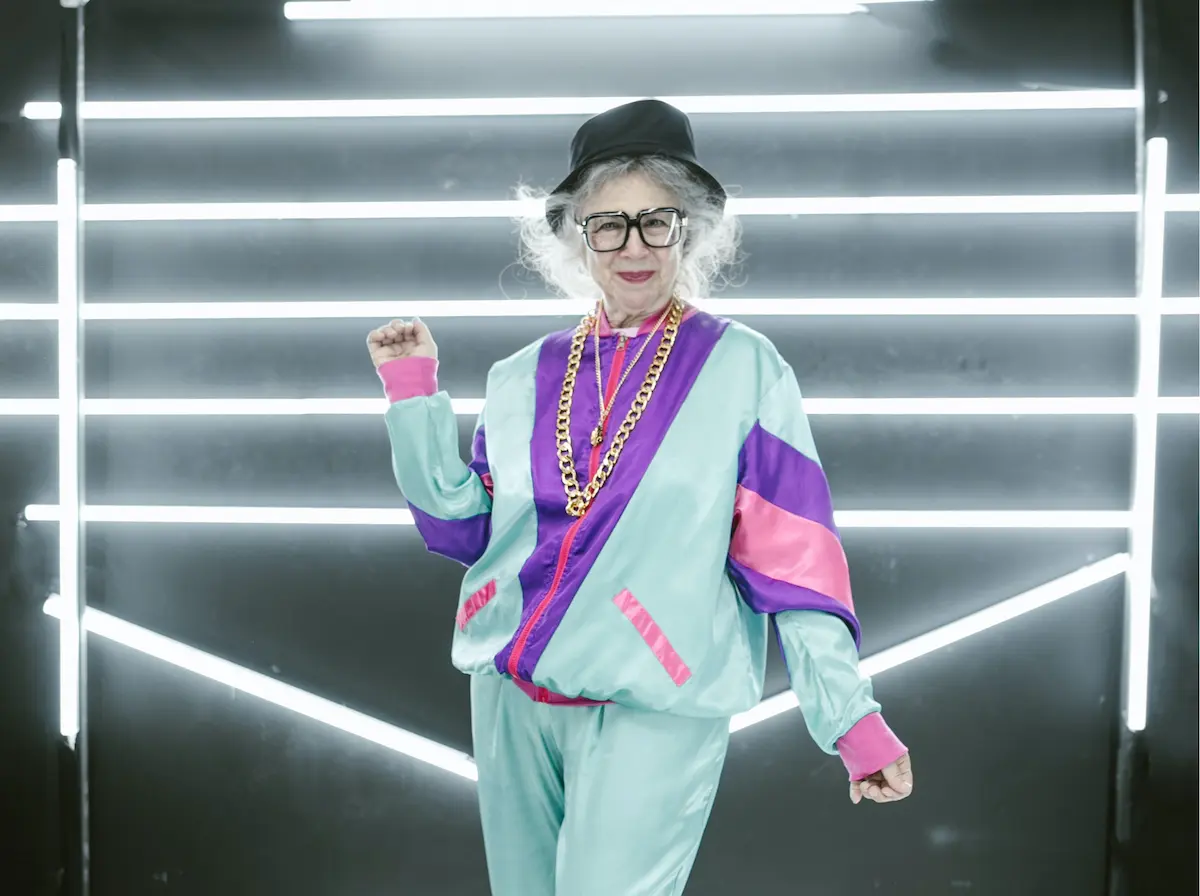
Since I live in Spain, I had to start building up my social contacts again from scratch. The place I chose happens to be home to many retired people. And honestly? That never bothered me.
Getting older has never scared me — not once. I’ve never looked at someone’s age when deciding whether I want to connect with them. I’ve met 85-year-olds with more energy, curiosity, and motivation than many 25-year-olds I know. I truly believe that whoever stays young in spirit never really gets old.
Of course, the body changes — but life force shines through physical appearance when someone is alive inside.
Recently, I saw a post in a Facebook group. A guy wrote that he wanted to meet new people. I reached out, and we agreed to meet. Then I noticed a detail I had missed: he wrote that the preferred age range was 20–30.
Oops. I’m 40.
I hesitated for a second — then decided to be honest. I wrote back, saying that I might be a bit “older,” but that in spirit, I feel somewhere around 26. His response?
No issue at all.
That moment stayed with me — not because it was uncomfortable, but because it revealed how quickly age becomes a mental barrier, even when no one actually enforces it. These experiences made me reflect that maybe it would be useful — even necessary — to write about this topic.
Because why age doesn’t matter and why it does in personal growth and relationships is something we rarely look at with honesty and nuance.
🌍 Introduction: The Age Paradox
Age is often one of the very first things we ask about someone — and one of the last things that truly defines who they are.
We use age, often unconsciously, to categorize people, predict behavior, and create expectations. We assume how flexible someone might be, how open, how energetic, how “set in their ways.” And yet, when we really look around, some of the most vibrant, curious, and emotionally alive people we meet don’t seem to “match” their age at all.
At the same time, we’ve probably all experienced moments when age suddenly did matter — when our body asked for more rest, when life experience gave us deeper insight, or when generational differences became visible in communication or values.
So why does age sometimes feel completely irrelevant… and at other times undeniably important?
The answer lies in learning to hold two truths at once:
Age can influence our physical reality and life context — without defining our spirit, identity, or capacity for growth.
Exploring this paradox helps us understand how age relates to self-development, relationships, and emotional wellbeing — not as a rigid label, but as one dimension of a much richer human experience.
🧠 Psychology & Science: Age vs. Inner Age
Modern psychology makes an important distinction between chronological age (how many years we’ve lived) and subjective age — how old we feel on the inside.
Interestingly, research shows that subjective age is often a much stronger predictor of wellbeing than the number on our birth certificate.
Studies consistently suggest that:
- People who feel younger than their chronological age tend to live longer
- A younger inner age is associated with better mental health and resilience
- Curiosity, purpose, and identity drive motivation far more than age itself
Our brains remain plastic — capable of learning, adapting, and changing — well into later life. Novelty, meaning, and emotional engagement keep neural pathways active. In that sense, growth has very little to do with age, and a lot to do with mindset and environment.
However, age does matter in important and practical ways:
- The nervous system processes stress differently over time
- Life experience often brings greater emotional regulation and perspective
- Physical recovery, energy cycles, and hormonal balance change
The psychological challenge is not to deny these realities — but to integrate them wisely.
Age becomes limiting only when we confuse biological changes with loss of identity or possibility.
The real skill lies in discerning where age offers wisdom and self-knowledge — and where it should not be allowed to restrict curiosity, connection, or reinvention.
🌏 Cultural Perspectives: How Societies See Aging
How we experience aging is shaped not only by biology, but very strongly by culture. Every society carries an unspoken story about what it means to grow older — and we often internalize that story without realizing it.
Different cultures send very different messages:
- Mediterranean cultures tend to emphasize social bonds, daily rituals, and shared presence. Older people remain visible, involved, and emotionally connected to community life.
- Many Asian cultures associate age with respect, authority, and accumulated wisdom, placing elders in mentoring or advisory roles.
- Western cultures, especially in recent decades, have largely glorified youth, speed, and productivity — often equating value with performance and appearance.
Historically, elders were knowledge keepers, storytellers, and emotional anchors. Aging was understood as a transition into a different kind of contribution rather than a decline.
Only in relatively recent centuries did aging become something to resist, hide, or “fix.” This shift has deeply influenced self-worth in societies where visibility and relevance are tied to youth.
When aging is framed as loss, fear often follows. When it is framed as evolution, dignity and purpose remain intact.
🌍 Fascinating Cultural Facts About Aging Around the World
Looking beyond general cultural patterns, certain countries offer especially insightful examples of how aging can be lived, perceived, and supported in very different ways. These snapshots reveal how social values, daily rituals, and collective attitudes can profoundly shape not only longevity, but also dignity, purpose, and quality of life in later years.
🇯🇵 Japan – Aging as Social Capital
Japan has one of the highest life expectancies globally, but what stands out is how aging is socially integrated. The national holiday Respect for the Aged Day honors older adults as contributors rather than dependents. Many remain active through community roles and intergenerational programs, reinforcing purpose well into later life.
🇮🇹 Italy – Longevity Through Belonging
In many Italian villages, older adults are rarely isolated. Daily rituals such as shared meals and evening walks (la passeggiata) create ongoing social engagement. Research from Italian “blue zones” suggests that belonging and connection are as vital for longevity as nutrition or movement.
🇸🇪 Sweden – Aging Without Urgency
Sweden emphasizes autonomy and balance in later life, without the pressure to remain youthful. The cultural principle of lagom — “just enough” — supports acceptance of life stages, reducing anxiety around aging.
🇮🇳 India – Wisdom Grows With Age
In traditional Indian culture, aging often marks a shift toward spiritual authority. Older adults may step back from material ambition and move into roles of guidance and teaching, viewing later life as a deepening rather than a diminishing.
🇨🇷 Costa Rica – Purpose as Longevity Medicine
In Costa Rica’s Nicoya Peninsula, elders frequently speak of plan de vida — a reason to wake up each day. Aging here is associated with usefulness, continuity, and meaning, contributing to lower stress and longer life expectancy.
🌱 Why These Cultural Differences Matter
These examples highlight a powerful truth: aging itself is not the main determinant of wellbeing — the narrative surrounding aging is.
When societies keep elders visible, value contribution over appearance, and honor wisdom alongside vitality, people tend to age with greater confidence and inner peace.
Recognizing this allows us to distinguish cultural conditioning from personal truth — and to consciously choose which stories about aging we want to live by, and which ones we are ready to release.
⏳ What Changed Over the Last Centuries?
Several major developments transformed how we relate to age:
- Industrialization tied human value to productivity, efficiency, and output
- Capitalism and media reinforced the idea that youth equals desirability
- Social media amplified comparison and aesthetic ideals, compressing age into a visual hierarchy
- Medical advances extended lifespan faster than emotional or cultural frameworks could adapt
We now live longer than any generation before us — but without clear emotional models for how to age meaningfully. Many people feel caught between longer lives and outdated narratives about relevance and worth.
This gap often creates:
- Fear of becoming invisible
- Pressure to “stay young” rather than stay authentic
- Artificial limits on learning, love, and reinvention
Reframing age as an evolving relationship — rather than a countdown — allows us to meet each phase of life with curiosity instead of resistance.
🛠️ Practical Insights & Exercises
Understanding age on a deeper level is not just an intellectual exercise — it becomes meaningful when we relate it to our own inner experience. The following reflections and practices are designed to help you explore your relationship with age gently, honestly, and without judgment, so insight can turn into lived awareness.
🌱 Reflection Exercise: Discovering Your Inner Age
Set aside 10–15 quiet minutes and reflect honestly. Write by hand if possible.
Ask yourself:
- When do I feel most alive, curious, and engaged with life?
- How old do I feel in those moments?
- What activities, people, or environments bring that feeling forward?
- When did I first absorb the idea that age should limit me?
- Whose voice does that belief belong to — mine, or society’s?
Notice patterns. Your inner age often reveals what your nervous system and soul need — not what you “should” be doing at a certain stage of life.
🔄 Reframing Exercise: Age as Information, Not Identity
Notice how often age-related thoughts appear in daily language.
When you catch yourself thinking:
“I’m too old for this.”
Pause and gently reframe:
“My body has different needs now — and my curiosity is still alive.”
Or:
“I bring experience and openness to this moment.”
Repeat the new sentence out loud. Observe how your body responds.
Language shapes perception — and perception shapes possibility.
🤝 Relationship Awareness Practice: Meeting Beyond Age
In your next social interaction, practice suspending assumptions.
Consciously avoid guessing:
- Someone’s energy level
- Their openness to change
- Their emotional maturity
- Their interests or worldview
Instead, anchor yourself in presence. Listen for tone, curiosity, and responsiveness rather than age cues.
After the interaction, reflect:
- What surprised me?
- Where did my assumptions dissolve?
- How did the connection feel when age was not the reference point?
This practice alone can transform how we relate — across generations and within ourselves.
🌟 Final Words
Age matters for the body.
Age shapes experience, perspective, and wisdom.
But age does not define our curiosity, our depth, our humor, our courage — or our capacity to truly connect.
When we begin to understand where age guides us and where it should gently step aside, we open the door to greater compassion — for ourselves and for the people we meet along the way. This awareness allows us to live with more freedom, authenticity, and trust in our own rhythm.
If reading this stirred something in you and you’d like to talk it through together, you’re welcome to reach out via the contact form — you’ll find more about one-to-one conversations under the “Talk with me” menu.
📚 Related Articles
The Top 5 Regrets of the Dying – A powerful reflection on what truly matters at the end of life — and how awareness today can prevent regret tomorrow.
Embracing Zen Lessons – An exploration of mindfulness, simplicity, and presence as tools for inner freedom at any age.
📖 Recommended Reading
Here are five best-selling books that beautifully explore aging, meaning, and inner vitality, offering inspiration for every stage of life:
- Ikigai by Héctor García & Francesc Miralles – Explores purpose, longevity, and how meaning — not age — fuels a fulfilling life.
- Man’s Search for Meaning by Viktor E. Frankl – A timeless book on finding purpose through all stages of life and suffering.
- The Art of Aging by Sherwin B. Nuland – A compassionate look at aging with dignity, realism, and wisdom.
- Being Mortal by Atul Gawande – Challenges modern views on aging, medicine, and what makes life worth living.
- Younger Next Year by Chris Crowley & Henry S. Lodge – Practical insights on staying physically and mentally vibrant over time.
💬 Questions for You
🧠 How old do you feel on the inside — and when do you feel most alive?
🌍 Have you noticed cultural differences in how age is treated?
💞 Did age ever stop you from connecting with someone — or did you challenge it?







Leave a Reply